A Dance to the Music of Time1634
Nicolas PoussinFrance
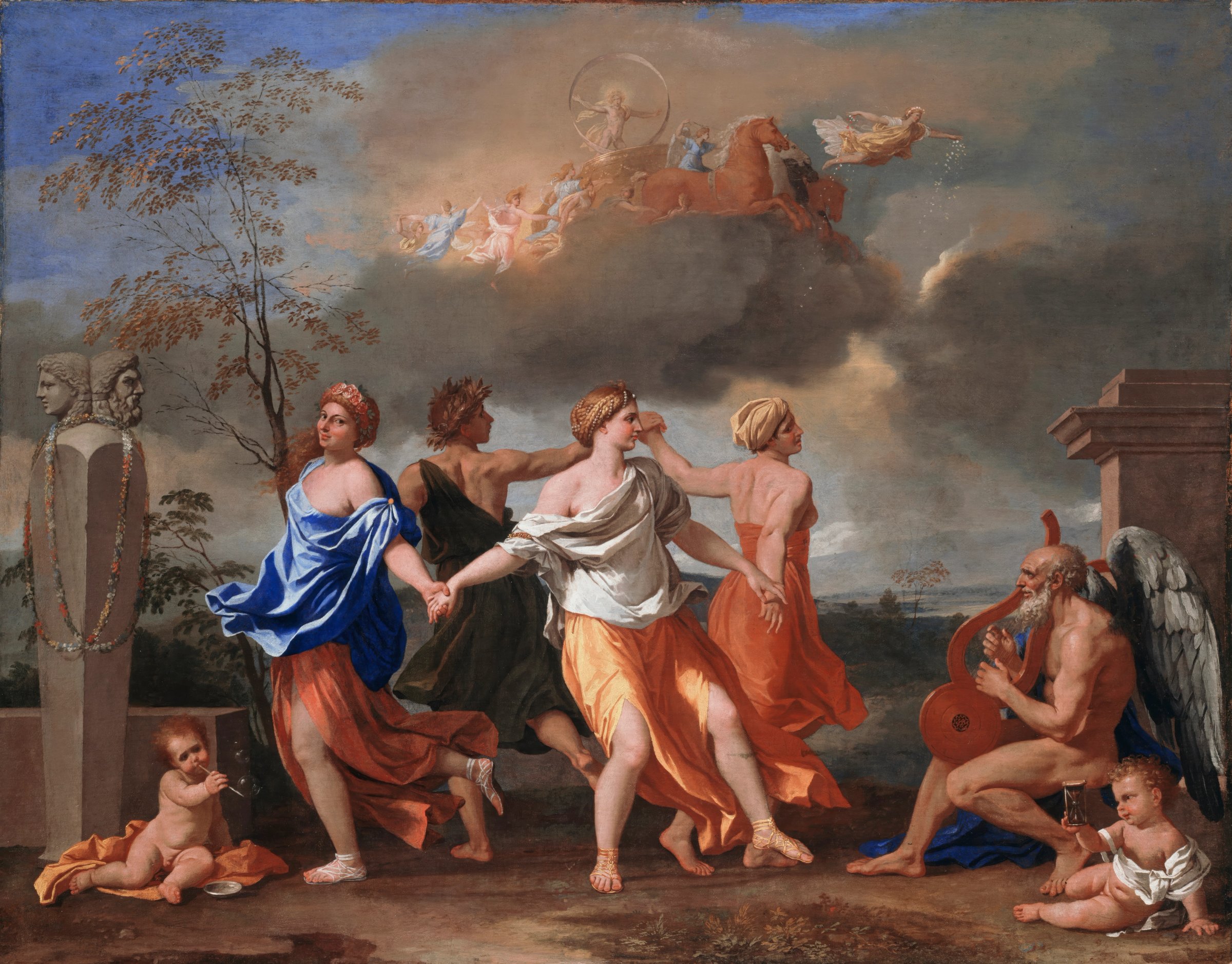
A Dance to the Music of Time by Nicolas Poussin.
Oil on canvas artwork from 1634 in France during the baroque movement.
History
A Dance to the Music of Time depicts a scene of four dancers, each representing a principle of the human condition, and a corresponding season. Beginning from the man behind, clockwise; Poverty and Autumn, Labour and Winter, Wealth and Spring, Pleasure and Summer. It is generally accepted that the male figure depicted actually represents Bacchus (Dionysus), following the story of Les Dionysiaques that tells of Jupiter (Zeus) providing the gift of Bacchus, his wine and all of his pleasures that he embodies to the world, as a compensation for the hardships and conditions that humans must endure. The three women dancing hand in hand, bare a striking resemblance to The Three Graces, who in themselves are also children of Zeus (and servants to Apollo), and embody a similar set of traits, those being Beauty, Abundance, and Joy.
Amongst the charming details in this painting is the hand of Labour reaching out in an attempt to reach Wealth. This bears a symbolic resemblance to that of the Creation of Adam by Michelangelo. Adam reaches his hand out to God, but in order for them to finally connect, Adam must himself outstretch his finger fully, in the same way that the face of desperation on Labour, and that of contempt from Wealth, signifies that the burden of effort in order to reach Wealth, is on Labour.
Beside this dance we see Cronos in his typical depiction as an old man, closely accompanied by a young boy, perhaps a cherub, symbolising the opposite end of life - the beginning, with his hourglass still full. In this scene, Cronos is watching the dancers intently, not just a spectator but directly participating, as he plays the lyre. We could suggest symbolically that this represents humanity plays to the tune, the rhythm, and at the behest of time, bound by the relentless tempo of Father Time. The music, whether we continue to dance or not, persists.
Opposite Cronos, next to Spring, our leftmost dancer, we see a plinth baring the head of Janus, the God of transitions and new beginnings, draped in flowers (perhaps the same as those delivered by Aurora). Close by, we see a young boy next to the dancers, blowing bubbles, symbolising the fleeting and fragile nature of life. As the eyes of Spring meet us, she becomes the focal point of the whole painting, and as she stands beside Janus, amongst the yellowing trees of Autumn from the vibrant greens of Spring, we can imagine that this scene depicts the transition from Spring to Autumn.
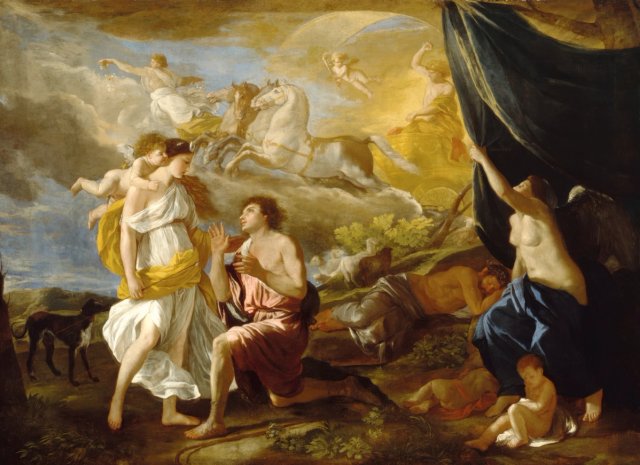
In the background, clearly and completely painted across the sky, we see Aurora (Eos, Dawn) leading the chariot of Apollo, followed by Horae, the personification of hours. The Zodiac Wheel of Apollo, the blossom of Aurora and the dance of the Horae, embody the introduction of day to night, and are presented as the celestial macrocosm of the dance of humanity, to the music time.



















No works match these filters.